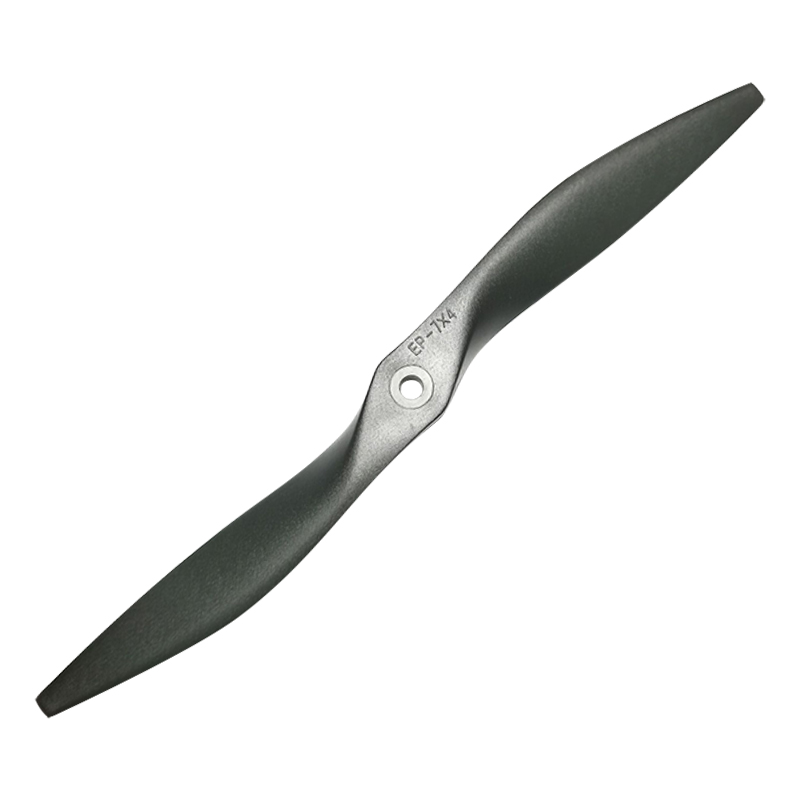
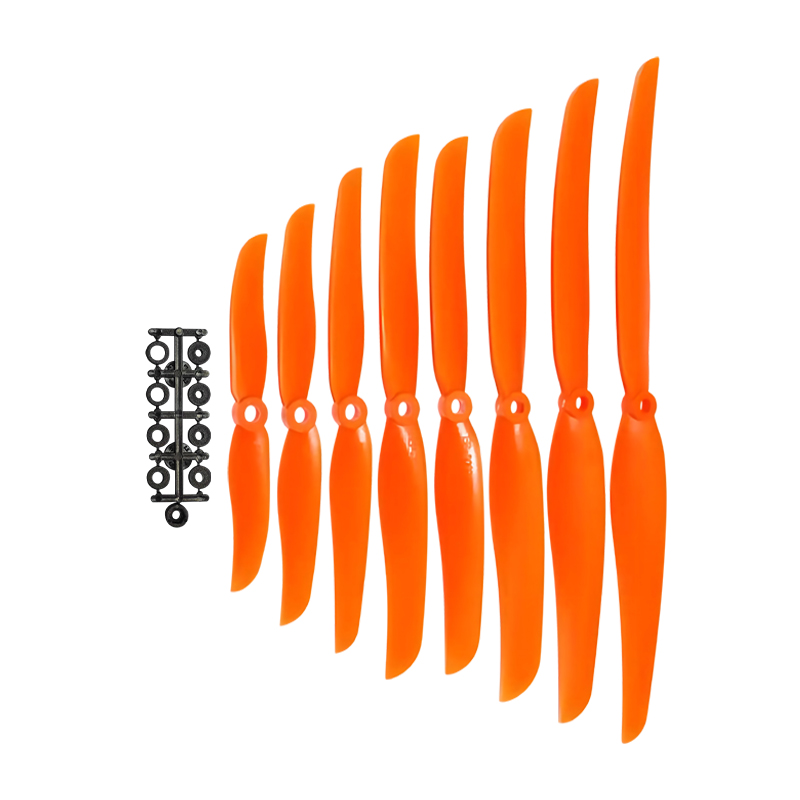
10 Pcs 2 Blade Propeller 5030 6030 7035 8040 8060 9050 1060 1160 Direct Drive High-Speed Pro Color Orange Rc Accessories
Package Included:10pcs
With washer of 3/3.2/3.5/4/4.8/5/6/6.35mm
1 PC N.W.:
001-03001:2.5g
001-03002:3.2g
001-03003:4g
001-03004:5.7g
001-03005:7.9g
001-03006:9g
001-03007: 10.8g
001-03008: 10.2g
Product Overview
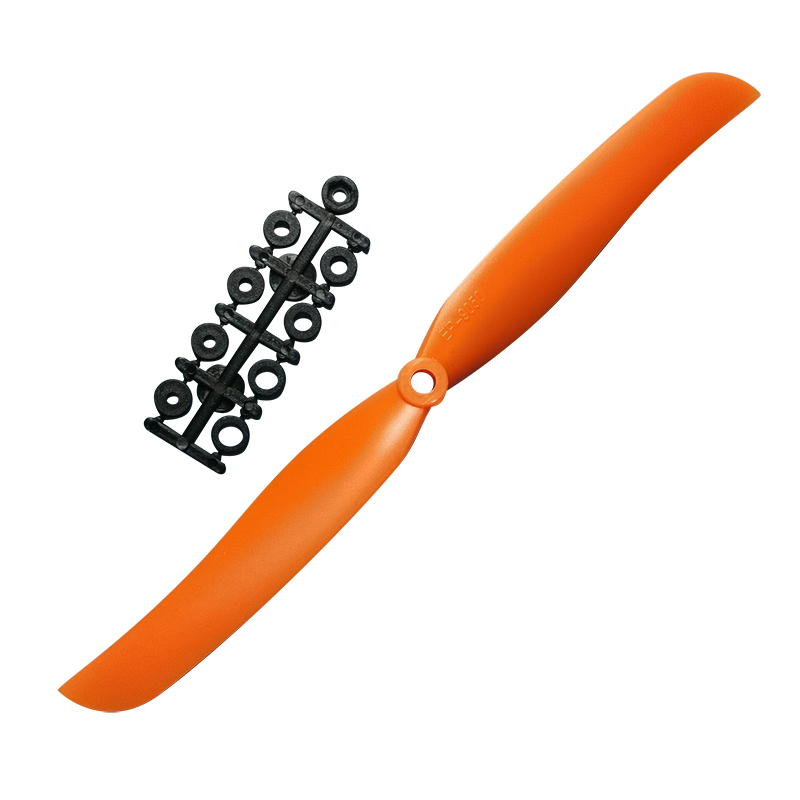
A propeller transfers motor rotation into forward thrust for fixed-wing RC aircraft. This set includes 10 two-blade direct-drive high-speed propellers covering common sizes from 5030 up to 1160. Matching reducer washers are supplied to adapt the hub for multiple shaft diameters. These high-speed props are designed for direct-drive power setups on sport RC planes. They are widely used for new builds, spare stock, or replacing damaged propellers after ground strikes. Modellers often keep mixed-size prop packs for field repair, as propellers are consumable parts that suffer damage easily on impact.
Material & Build
These propellers are injection moulded plastic, the standard material for lightweight direct-drive RC propellers. Plastic construction keeps rotational mass low, reducing motor load during acceleration. Each blade pair is shaped for high-speed flight, optimized for forward speed rather than maximum static thrust. The central hub accepts the included reducer washers to fit a wide range of motor shaft sizes. Factory balancing is not guaranteed for every unit. Static and dynamic balancing before flight is standard practice for all RC propellers. Plastic will deform or crack upon heavy impact, limiting shock transfer to the connected motor shaft.
Size & Fitting Guide
Available sizes: 5030, 6030, 7035, 8040, 8060, 9050, 1060, 1160 Included reducer washers fit shafts: 3/3.2/3.5/4/4.8/5/6/6.35mm High pitch direct-drive props are suited for sport planes built for faster flight. Always select by diameter and pitch, not visual appearance. Use the included washer set to match the prop hub bore to your motor shaft. All listed dimensions are manually measured with 1–3mm tolerance. Product photos are for reference only.
Design & Compatibility
Two-blade direct-drive layout delivers low drag and high top speed, best matched for sport RC airplane power systems. The interchangeable washer kit lets one prop fit multiple shaft sizes, reducing the need for separate prop adapters. These props are made for electric direct-drive power systems. They are not suitable for glow or gasoline engines.
- 2-blade direct-drive high-speed propellers
- 10 Pcs per pack, mixed sizes from 5030 to 1160
- Orange colour
- Assorted reducer washers for multi-size motor shafts
- Lightweight plastic construction
- For sport RC airplane assembly and spare replacement
Applications Across RC Models
Electric sport RC planes: The high-speed pitch profile suits fast flying sport airframes. New model assembly: A mixed-size pack supports building multiple RC planes with different power setups. Crash & wear replacement: Quick swap for broken or nicked propellers after landing impact. Bench stock for flying clubs: One pack covers many common sizes for different builders.
Installation & Balancing
Choose the matching washer to fit your motor shaft, install the washer inside the prop hub, then fasten the prop securely. Confirm the prop runs co‑axially with the motor shaft. Complete static balance and dynamic balance testing before flight. Unbalanced propellers create vibration that can damage motor bearings and loosen airframe parts. Check blades and hub for chips or cracks after every landing. Damaged props must not be flown. High-speed props place higher load on the power system. Verify your motor and ESC can handle the current draw before full-throttle operation.
Workshop Repair & Maintenance
Inspect each prop after contact with the ground or debris. Hairline cracks or blade deformation mean replacement is required. Store spare props flat away from heat to avoid blade warping. When switching to a larger or higher-pitch prop, monitor motor temperature during test runs to avoid overload. Keep spare props in your flight field kit for emergency replacement.
CAUTION
For the great amount of propellers with varied types of different purposes, users should fly with them follow the instruction below for safety:
1.Please run your propeller with proper power system, and please do some necessary adjustment with test of static/ dynamic balance seriously, or you will easily have it damaged;
2.When the power system is working, please make sure that there is no one standing in front or on either side of it ( or its intake, if it is an electric ducted fan power system), preventing it from flying off unexpectedly and causing danger;
3.If there are some cracks or any structural damages on the propeller, please displace another one as soon as possible to prevent it from flying off into pieces and causing danger;
4.Before flying, please make sure the propeller is fixed well through the motor shaft and the two of which are in the same axis;
5. Please make sure the runway is clean, because such things like branches and little stones and easily cause danger and damage to people all around and the plane itself.
- This guide can also be applicable in the term of “Ducted Fan Power Units”.
FAQ
Q: How to select the suitable size propeller?
A: Match the diameter and pitch to your motor KV, ESC and airframe requirement. Higher pitch is for faster flight while larger diameter delivers more thrust.
Q: What should I check before every flight?
A: Inspect blades and hub for cracks, deformation or nicks. Confirm the prop is tightly fixed and runs concentrically on the shaft.
Q: Why does the prop vibrate during running?
A: Vibration is usually caused by imbalance, bent blades or loose installation. Stop operation immediately and recheck balance and fitting.