Hinge Plate Overview
This is a plate-type adjustable hinge for the larger moving panels on a model aircraft — the hatches, canopy frames, battery doors and access covers that need a wide, free swing rather than a small hinge that barely cracks open. Both leaves are pressed from aluminium alloy with a silver metal finish, flat and broad enough to sit against the surface they join instead of sinking into a slot. Each leaf carries countersunk screw holes, so a flat-head screw finishes level with the face, and the barrel joint along the spine ends in a pin with a black cap at the tip.
That pin is the detail that changes how you use the hinge. Draw it out and the two leaves separate, which is what makes this pattern a favourite for canopies and battery hatches that have to come off completely at the field. In place, the leaves rotate freely through a large angle range, so the panel opens far enough to get your hand past the frame without fighting it.
A plate spreads the fixing load across a wider area than a hinge barrel does. On a foam hatch lip or a light ply frame, that extra face is often the difference between a hinge that stays put and one that pulls through after a season of landings, and it is the main reason builders keep one of these in the hardware drawer beside their pin hinges.
The hinge sits in the 008-Hinges section of our rc airplane parts range, next to the metal pin hinges and the lightweight cabin hinges, and every piece is supplied as new stock. Ordering from our rc airplane parts online range gets you something ready to fit as it arrives — two leaves, a barrel, a pin, no assembly.
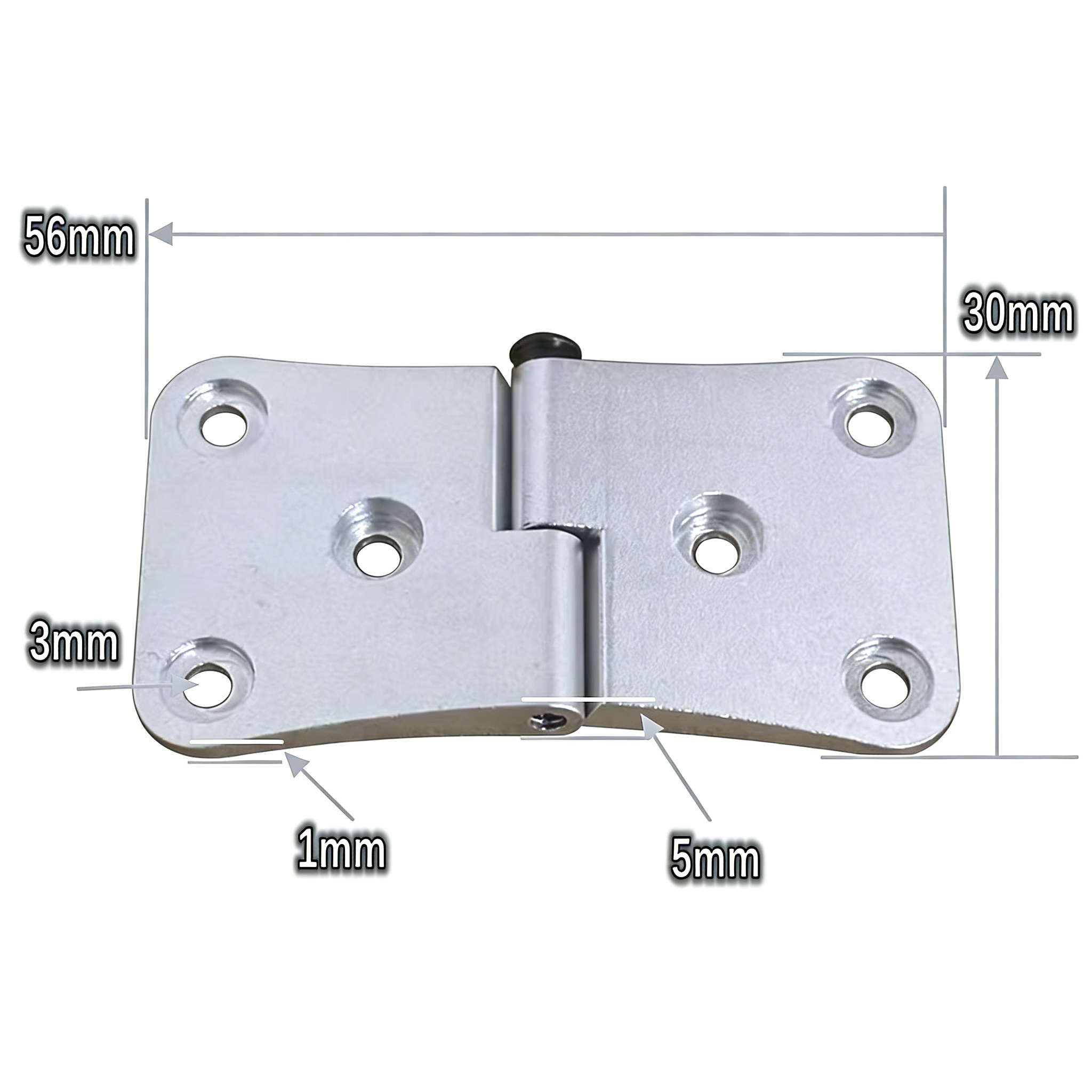
Specifications
| Product type |
Adjustable plate hinge |
| Units |
Millimetres |
| Plate length |
56 |
| Plate width |
30 |
| Material |
Aluminium alloy |
| Finish |
Silver metal |
| Rotation |
Flexible movement over a large angle range |
| Mounting |
Countersunk screw holes |
| Pin |
Removable barrel pin with black cap |
| Pieces per pack |
1 |
| Range section |
008 - Hinges |
| Condition |
New |
Applications
- Canopy and hatch frames on scale models. The plate screws to the hatch lip and the frame, and the wide swing lets a canopy lift clear instead of scraping along the fuselage side. Most of the rc airplane hinges we sell in this size end up doing exactly this job.
- Battery and equipment bay doors. Pull the pin and the door comes away completely for charging or a servo swap, which beats holding a hatch open with one hand while you work with the other.
- Cowl and side access panels on nitro and gas airframes. A broad plate holds far better than a small hinge on a cowl that has to open for needle adjustment, and fitting two keeps the panel square as it swings.
- Rudder and elevator on larger electric models. Where the surface is thick enough to take a plate and the hinge line is exposed, a wide leaf spreads the load across more of the trailing edge than a slim barrel would.
- Wing access panels and servo covers. Small covers that have to lie flat on the bench while you work inside the wing, with the cover still attached so it does not end up in the grass.
- FPV and drone payload doors. Builders who buy rc airplane hinges for drone frames use it on camera and battery doors where the panel needs to swing clear and come off for maintenance.
Hinge Types Compared
| Hinge pattern |
Mounting face |
Swing and pin |
Where it fits |
| Adjustable plate hinge (this one) |
Broad two-leaf plate with countersunk screw holes |
Large angular swing, pin lifts out |
Hatches, canopies and panels that open wide and detach |
| Metal pin hinge |
Slim round barrel set into a drilled slot |
Small throw, fixed pin |
Ailerons, elevators and rudders with a hidden hinge line |
| Lightweight cabin hinge |
Small aluminium unit, roughly 4–4.2 g |
Free rotation, fixed pin |
Cabin openings and equipment bays where weight matters |
| Moulded canopy latch |
Moulded body with a bolt hole through the base |
Holds the hatch shut, no swing |
Cockpit lids that clip closed instead of hinging open |
| Aluminium canopy lock |
Machined body, straight or right-angled |
Holds the hatch shut, Ø3 bolt |
Corner-mounted hatches on F3A models and drones |
Installation And Upkeep
- Dry-fit the hinge before you drill anything. Hold it against the hatch and the frame with the panel closed, and check that the barrel sits on the outside of the joint where it can swing without binding.
- Check the swing where the panel will actually open. Lift it to the angle you want and look for contact with the fuselage side or the cowl; if a leaf fouls, the barrel needs to sit further out from the joint.
- Mark and centre-punch the countersunk holes with the hinge held steady, so the drill bit does not wander across foam or thin ply.
- Drill pilot holes a little under your screw size and test one screw before you commit to the rest. If it feels tight, open the hole a fraction rather than driving the screw home and stripping the material around it.
- Fasten the hinge to the moving panel first, then offer that panel up to the frame. Working in this order keeps the hinge line straight; doing it the other way usually forces the plate to follow a frame that was marked slightly off. Moving part first, fixed part second, is also the order that works well for most rc aircraft parts of this kind.
- Work the panel through its full travel a dozen times before you go further with the build, listening and feeling for any point where the barrel starts to bind.
- Re-check the screws after the first flights and again at the start of each season. Small screws work loose on models that see hard landings, and a plate that has lifted a turn or two will start moving the panel before the hinge shows any wear at all.
- Keep the barrel clean and dry. Grit, dried fuel residue and grass are what wear a hinge joint, so wipe it after a session and add a single drop of light oil — heavy grease collects dust and makes the swing stiff. Keep a spare pin in the field kit, because a pin bends rather than breaks and straightening one repeatedly loosens it in the barrel, and store spare hinges flat in a parts box instead of loose with the rest of the bench.
Related Parts For The Same Build
- Metal pin hinge, Ø4.5 × 68, pack of five. The natural partner for this plate. Builders who buy rc airplane parts online for a new airframe usually take the plate for the hatch and a pack of pin hinges for the smaller flying surfaces.
- Lightweight cabin hinge, L40 × 18 / 15. The light aluminium option for cabin openings, cockpit doors and equipment bays where the plate would be more hinge than the job needs.
- Adjustable engine mounts, 20–180 class. Made for methanol and gas engines, and worth having beside the bench when a new airframe is being set up and the engine has to come out again for break-in.
- M6 threaded nylon thumb screws, L30–75. For hatch lips you want to open by hand at the field without hunting for a hex driver in the flight box.
- Tube bender for 3.2 / 4.0 / 4.7 wire. Pushrods and landing gear legs get shaped on the same bench, and a clean bend keeps the linkage running free once the surface is hinged.
- Silicone exhaust deflector for nitro models. It turns exhaust away from the cowl, which keeps residue off the hinge, the covering and the film behind it.
- Control horns, clevises and pushrods. A hinged surface is only as good as the linkage driving it — these are the small rc aircraft parts that finish the job.
Customer Reviews
This hinge plate is a recent addition to the listing, so there are no buyer reviews on it yet. Reviews are published from verified purchases, and the details that help the next builder most are the plain ones: the model and panel it was fitted to, the screw size that matched the countersunk holes, how much swing the opening needed, and whether the pin came out easily when the panel had to be removed. Anyone ordering from our rc airplane parts online range can leave that note from their account once the build is finished.
If you would rather not wait for a review to appear, send us the panel dimensions and the way the hatch opens, and we will check the plate and its screw holes against them before you order. Catching a sizing problem at that point costs nothing; catching it after the parcel arrives costs a build day.
Fit notes from the bench are also how a range of rc aircraft parts gets better. When several builders report the same tight hole or the same barrel fouling a particular hatch, it becomes something we look at on the next production run.
Ordering And Delivery
- Check the plate against your opening before you order — length, width, hole positions and the screw diameter you plan to use. Sizing is the one thing that cannot be corrected once the part has crossed a border.
- Work out how many pieces you need. Whether you buy rc airplane parts one at a time for a single repair or keep a drawer of them for the repair bench, this hinge is supplied as one piece per pack, and most hatches and canopies take two.
- Allow for hand measurement. Dimensions are taken by hand, so a difference of up to about 1–3 between the listed figure and the piece in the bag is normal on a part this size.
- Judge the finish by the description rather than the screen. Lighting and monitor settings can shift the tone of a metal part, so treat the photographs as a guide to shape and finish, not an exact colour match.
- Remember that the images are close-ups and not to scale. Size your build from the dimensions above, not from the picture.
- Plan around the order cycle. Order handling runs at 24–48 hours; confirm the current schedule with your sales contact before building a day around a delivery date.
- Ask about supply. Shops and clubs that buy rc airplane hinges or other hardware in quantity can talk to their sales contact about pack sizes, sample availability, payment methods for their country and current terms.
- Mention any packing requirement. Small hardware is normally bagged so the pieces stay countable in transit — say so if you need a particular arrangement for a stock room.
Scale & Supply Capability
Compo RC is part of Haoye Model, working in RC accessories since 1999 — 25+ years of experience, an ISO 9001 certification dating back to 2002, and 1,200+ dedicated moulds behind the range. A 6,000 m² production base and a catalogue of 3,000+ items mean you can source the many small parts a build needs from one place. Need a size we don't list? Send your drawing and we'll make it to your specification. Unsure whether something will suit your build? Our team will help you check before you order.
FAQ
Q1. What is the hinge plate made of, and how does it look once it is fitted?
Both leaves are aluminium alloy with a silver metal finish — smooth metal with a soft sheen rather than a polished mirror. The pin at the barrel end is capped in black, which is the only colour break on the part. Once fitted, the countersunk holes let a flat-head screw sit level with the face, so the plate reads as neat hardware rather than a raised fixing.
Q2. Can the pin be taken out so the panel lifts off?
Yes. The pin is a lift-out type with a black flared end, and the two leaves separate once it is drawn out of the barrel. That is how builders use it on a removable canopy or a battery hatch — work the pin free with a small drift or a pair of pliers with tape over the jaws, and keep it in the parts box while the panel is off. Check that the pin slides freely before final assembly; a pin that has been straightened more than once will start to sit loose inside the barrel.
Q3. How far does the hinge open?
The leaves rotate freely across a large angle range, so the panel swings well clear of the frame. We do not publish a swing angle in degrees for this part, so hold it against your opening and test the movement before you drill — if the panel has to travel past a right angle or clear a thick fuselage side, check that arc on the bench first.
Q4. What screw fits the countersunk holes?
The holes are countersunk for a flat-head screw, and the head finishes flush once it is tightened down. We do not quote a single screw diameter for this plate, so offer up the screw you plan to use and check the fit in the hole before drilling the frame. If you need the hole measured for a drawing, ask and we will check a piece from the current batch.
Q5. Will a plate hinge suit my model, or should I use a pin hinge?
Choose the plate when the panel needs a wide swing and you have a flat face to screw into — a hatch, a canopy, a cowl panel or an access cover. A pin hinge is the better answer when the hinge line has to disappear inside two surfaces, as it does on most ailerons and rudders of smaller models. Both patterns are common rc airplane hinges, and plenty of builds use one of each: plate on the hatch, pin hinges on the flying surfaces.
Q6. How much does one hinge weigh, and where does it sit in your range?
We do not publish a per-piece weight for this plate hinge, and because it is a solid aluminium part rather than a moulded one, it is not the lightest option in the hinge family — if grams matter on a drone or an aerobatic model, ask us and we will put one on the scale from the current batch before you order. It sits in the 008-Hinges section of our rc airplane parts range with the pin hinges, latches, screws and fittings, so it can travel on the same order as the rest of the hardware for your build.